
EVENING POST: שְׁמַע (shema) — Hear
Hear: Shema for Tonight 🌙 Hebrew has one verb for hearing-and-obeying. English needs two.
Dear friend in the evening,
Yesterday we closed Psalm 23 with yashav — to dwell, to settle. Today we open the prayer that tells you what to do while you dwell.
The prayer Jesus prayed every morning of His life. The verse He called the greatest commandment (Mark 12:29).
It begins with a verb — and that verb is the one Christians most often miss.

🌟 Hebrew Focus
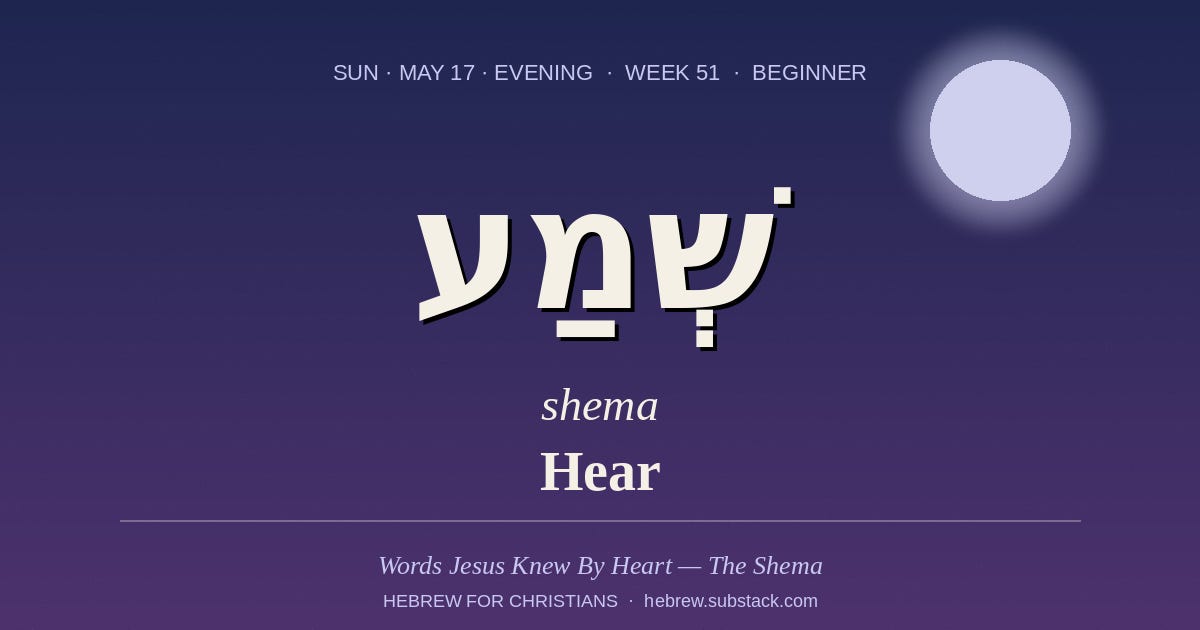
שְׁמַע (shema) — to hear — but also to heed, to obey, to act on what you’ve heard
English Bibles open the Shema with “Hear, O Israel.” A clear command — but a thin one. In English, hear and obey are two different verbs. You can hear without obeying. You can obey without hearing.
Hebrew has no such gap. שְׁמַע (shema) is one verb that means both at once. To shema is to hear and to heed. To listen and to act. When Israel is commanded to shema, they are not just being asked to perceive sound — they are being asked to let what they hear change them.
This is why every Jewish child still recites the Shema twice a day: morning and evening. Not as a creed to believe but as a verb to do. The praying is the obeying.
🔍 Beginner Hebrew
שְׁמַע — shema — hear / heed (imperative)
שָׁמַע — shamah — he heard (perfect tense)
שׁוֹמֵר — shomer — one who watches/keeps (same root)
שָׁמוֹעַ — shamoa — to truly listen (intensive form)
📖 The Pattern
“Hear, O Israel: the LORD our God, the LORD is one.” — Deuteronomy 6:4
The verse Jesus called the greatest commandment opens with one verb — and it is not “believe.” It is not “agree.” It is not “understand.” It is shema — hear and obey, in one breath.
Notice the order. Before the command to love (verse 5), before the command to teach the words to your children (verse 7), before the command to bind them on your hand (verse 8) — comes the command to hear. Everything else flows from the hearing.
In Hebrew, shema is the gateway verb. You don’t get to the love, the teaching, or the binding until you’ve first heard. And in Hebrew, hearing already includes the willingness to act.
🛤️ Practice (3 minutes)
Tonight, sit somewhere quiet. Phone face-down.
Say aloud, slowly: Shema Yisrael, Adonai Eloheinu, Adonai echad — Hear, O Israel, the LORD our God, the LORD is one.
Notice what you are about to do tomorrow. Ask: Have I been hearing — or just listening?
Sleep tonight as one who has been called by name to hear.
🎯 Reflection & Prayer
Father, You are not asking me to add information. You are asking me to be the kind of person whose hearing already moves their feet. Teach me to shema — to hear and obey as one verb. Tonight, I begin again. Amen.
🗣️ Transliteration & Pronunciation
shema — shuh-MAH. Two syllables, stress on the second. The opening sh is soft, the closing a is open like father.
💎 Premium Practice (12 minutes) — for paid subscribers
In today’s premium deep dive we have:
📄 The Shema — A Twice-Daily Practice Card (PDF) A printable double-sided card with the full Shema (Deuteronomy 6:4-9) in Hebrew, transliteration, and English. Designed to slip into a Bible or prayer journal — for morning and evening recitation.
📖 Shema Deep-Dive — The Verb That Means Hear-and-Obey Why Hebrew has one verb where English uses two. The Shema’s structural role in Deuteronomy. Why Jesus quoted it as the greatest commandment — and what that tells us about what love requires.
🎙️ Shema Audio (2 minutes) Two minutes opening the prayer Jesus prayed every morning of His life. Shema Yisrael — read at the pace it has earned.
👉 Unlock Premium Practice — $5/mo or $50/year to see the material below:
