
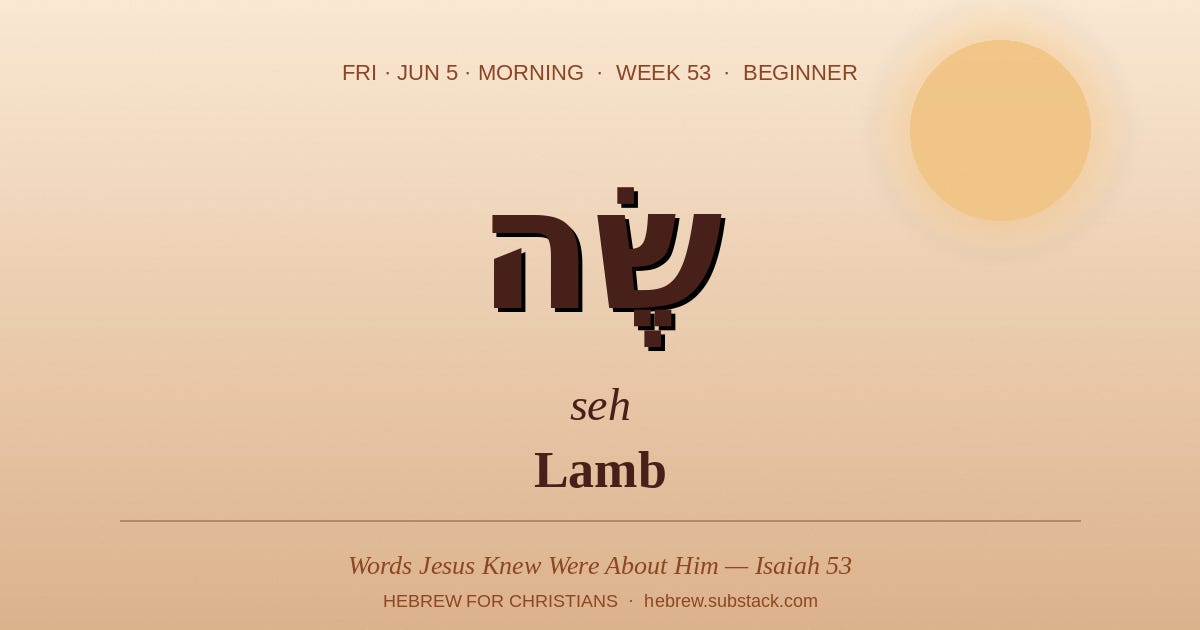
MORNING POST: שֶׂה (seh) — Lamb
Like a Lamb: Seh for This Morning 🌅 Verse 7’s image. The servant ‘led as a seh to the slaughter, silent as a sheep before its shearers.’ A whole biblical theology in one Hebrew word.
Dear friend in the morning,
Last night: avon. The twist laid on him by God Himself.
This morning: the image the prophet uses to describe how the servant carried it.
Ka-seh la-tevach yuval. “Like a seh to the slaughter, led.” Like a rachel — a ewe — before her shearers, silent.
One word, seh, opens onto the whole biblical theology of substitution.
🌟 Hebrew Focus
שֶׂה (seh) — lamb — the Hebrew animal of substitution, from Pesach to Isaiah to the Gospels
שֶׂה (seh) — a lamb, a young sheep. The word is broad — it can mean a lamb or a kid (young goat). What unites the usage is the animal of substitution.
Isaiah’s verse echoes Genesis 22. Abraham going up the mountain with Isaac. “Behold, the fire and the wood — but where is the seh for the burnt offering?” Isaac asks. And Abraham answers: “God will provide for himself the seh, my son.” The same Hebrew word.
It echoes Exodus 12. The Passover lamb. “You shall take a seh without blemish, a male of the first year… and the whole assembly of the congregation of Israel shall slaughter it at twilight.” The same word.
Isaiah 53 reaches for seh deliberately. The prophet is invoking the whole tradition. The seh of Abraham. The seh of Pesach. The seh of the daily temple offering. And he is saying: this servant is that.
When John the Baptist sees Jesus he says: Hineh seh ha-Elohim — “Behold, the seh of God, who takes away the sin of the world” (John 1:29). The Hebrew word survives directly in the Greek — amnos tou theou — but the Hebrew is what John was hearing. He was naming Jesus as Isaiah’s word, as Abraham’s word, as Pesach’s word.

🔍 Beginner Hebrew
שֶׂה — seh — lamb, young sheep (the substitution animal)
טֶבַח — tevach — slaughter
רָחֵל — rachel — ewe (Genesis names a matriarch with this word)
פֶּסַח — Pesach — Passover, where the seh is the lamb
📖 The Pattern
The full verse: He was oppressed, and he was afflicted, yet he opened not his mouth; like a seh led to the slaughter, and like a rachel before her shearers is silent, so he opened not his mouth. (Isaiah 53:7)
Two animal images. The seh led to slaughter, and the rachel before her shearers. Both silent. The Hebrew verb ne’elamah — “she became silent” — is the verb of intentional silence, not absence of speech.
This is striking because the Hebrew Bible normally lets victims speak. Job protests. The Psalms cry out. Even Jonah complains. The silent seh and the silent rachel are characteristic of sacrifice — the offering does not protest.
What the prophet is saying: the servant carries himself as the lamb did. Not protesting the substitution. Going to it as the seh always has, since Genesis 22.
The New Testament reads this directly. “As a sheep before its shearer is silent, so he opened not his mouth” (Acts 8:32-35). Philip uses this verse to preach Jesus to the Ethiopian eunuch. He starts at Isaiah 53:7 — the seh — and “told him the good news about Jesus.”
🛤️ Practice
Hold the word seh in your mind. Hear how Abraham’s seh, Pesach’s seh, and Isaiah’s seh are one Hebrew word repeated.
Notice the silence. The lamb led to slaughter does not protest. The Hebrew makes the silence intentional — chosen.
Name one thing this week where you have been protesting what you sense was given to you to carry.
Sit, this Friday morning, with the seh who was silent — and ask for his help in your own protest.
🎯 Reflection & Prayer
Father, your seh — your lamb — was silent in the carrying. The lamb of Abraham, the lamb of Pesach, the lamb of Isaiah, the lamb of John the Baptist. One word across all of scripture, naming what he did for me. This morning, give me his silence where I need it, and his voice where I need that. Amen.
🗣️ Transliteration & Pronunciation
seh — *SEH. One syllable. Short, open. Easy to say. The brevity is part of the word’s character — the lamb is unadorned.. The plural se’im* (lambs) does not appear in Isaiah 53 — only the singular. One lamb, for the many. The grammar matches the theology.
💎 Premium Practice (12 minutes) — for paid subscribers
In today’s premium deep dive we have:
📄 The Silent Lamb — A Friday Morning Reception (PDF) A worksheet that traces seh through Genesis 22, Exodus 12, Isaiah 53, and John 1 — and asks where in your week you need the seh’s silence and where you need his voice.
📖 Seh Deep-Dive — One Hebrew Word, Four Mountains Seh across the Hebrew Bible — Moriah (Genesis 22), Egypt (Exodus 12), Jerusalem (Isaiah 53), Bethany (John 1). How the same word organizes the whole biblical theology of substitution.
🎙️ Seh Meditation Two minutes on the Hebrew word that organizes scripture’s whole theology of substitution. Seh — Abraham’s, Pesach’s, Isaiah’s, John’s lamb.
🔊 Seh Pronunciation Drill All the Hebrew vocabulary from today’s deep-dive, pronounced slowly with say-it-after-me pauses. Perfect for your morning walk.
How to use this week’s Practice — and what you’ll get from it:
The worksheets are designed printer-light (black ink only, no color) and three-hole-punch friendly. Print them and keep them in a binder — your Hebrew Binder — because they’re built to compound. Over a year you’ll have a hundred-plus Hebrew words in there, each one with your own handwriting, prayers, and reflections. That growing binder is the Hebrew study — a custom artifact no app or curriculum could give you, made from the words that actually met you on the days they arrived.
The worksheet is for doing. Print it, fill it in as the week unfolds, three-hole-punch it, add it to your binder. By Sunday you’ll have something in your own handwriting — evidence, a prayer, an inventory — that you couldn’t have gotten from reading alone.
The deep-dive is for seeing. Read it once, slowly, at the start of the week. It traces the word across the whole Old Testament so the next time you meet it in scripture, you catch what you used to read past. Print it too — it lives in the binder ahead of its worksheet.
The audio is for carrying. Listen in a quiet moment — on a walk, before sleep. It puts the Hebrew in your ear so the word travels with you off the page.
By the week’s end, the word won’t be information you read once. It’ll be something you studied, prayed, wrote, heard, and kept — added to the binder you’re building, one Hebrew word at a time.
👉 Unlock Premium Practice — $7/mo or $70/year to see the material below:
